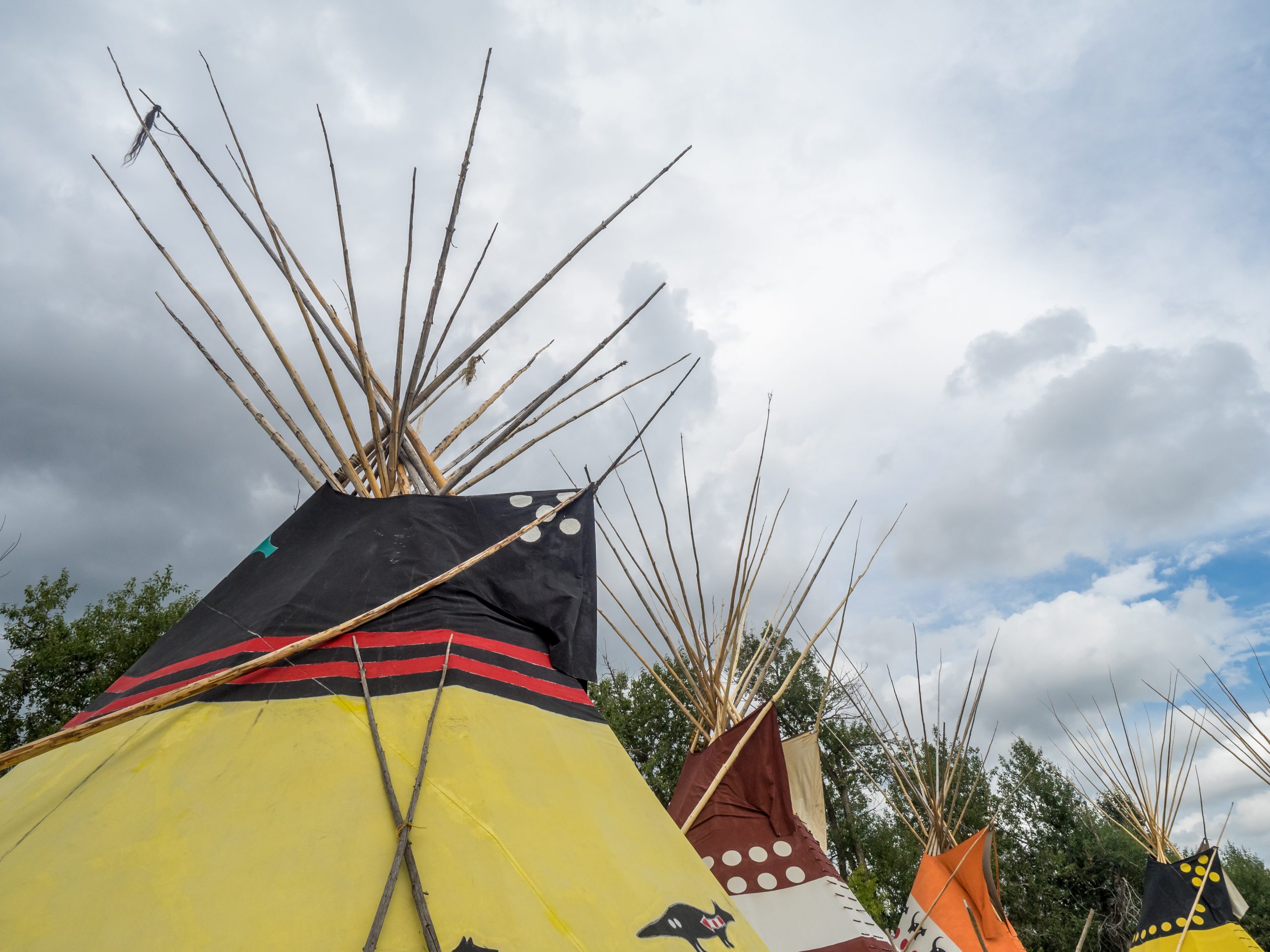
The Blackfoot, or Niitsitapi, which means “the Real People,” are an Indigenous confederacy made up of 4 tribes: the Piikáni, the Kainaiwa, the Siksikáwa, and the Aamskapi Pikuni. Traditionally, within each tribe, every individual assumed a role and contributed to the collective benefit of everyone.
You had men, women, children, and elders who performed the roles of storytellers, medicine keepers, leaders, warriors, food gatherers, hunters, protectors and society members such as the all female sacred buffalo society, the Motokiiks. Each woman member of this society understands the role of prayer and sacrifice for the collective, beyond the needs of the individual.
Historically, the success and survival of your tribe depended on collaboration and sharing one’s unique gifts with the collective group. Put simply, your skills were not your own to hoard.
What this means is Indigenous values are rooted in collaboration. It is arguably our most intrinsic of values. Our success as individuals and as a collective relies on supporting one another.
In 2026, Indigenous collaboration is more necessary than ever, particularly within technology, cybersecurity, data privacy and executive leadership roles.
If we consider the cybersecurity field alone, there is no better example of necessitating collaboration than amongst cyber threat intelligence networks. The defensive security community understands that each Security Operations Center (SOC) is no match for the current cyber threat landscape all by itself. We rely on shared threat intelligence in a world where bad actors are targeting entire sectors at once and First Nations and Indigenous Organizations with limited IT resources make very attractive targets.
Again, the success and survival of your tribe depends on sharing your gifts whereas hoarding knowledge leaves your communities exposed. For this reason alone, it is in the best interest of skilled Indigenous professionals to build a trusted network to share warnings, incident lessons, and vetted vendors with each other.
If we go further to assert our data sovereignty, these skillsets are even more urgently needed. Putting principles like OCAP® (Ownership, Control, Access, Possession) or the CARE principles into practice will require collaborative relationships between governance, privacy, cybersecurity, technology, and executive professionals.
Now, aside from our shared goals, we must also consider that regardless of the unfairness of this narrative, our individual reputations are tied to all of us, collectively. When Indigenous people visibly back each other, we build a shared credibility that we all benefit from. Comparatively, when we undermine each other we display division and inadvertently cause our non-Indigenous allies to doubt us.
That said, I am a Blood and I can only speak as a member of the Kainaiwa Nation. So, it should be noted that supporting each other is not submitting to a label of “sameness.” By noting our collective reputation, I am not suggesting that we offer one single voice but rather that supporting each other is a display of solidarity and respect for each other. Together, we are First Nations, Inuit, and Métis professionals from distinct nations with different languages, songs, and priorities.
We are each unique, with varying gifts to share with the collective, made stronger together.
So, ultimately, what I am proposing is that if you get in the room, hold the door open:
- Build (or join) an Indigenous network for threat intelligence and governance
- Refer individuals from your Indigenous network for jobs you can’t take on
- Publicly credit each other’s work and pursuits
- Mentor young Indigenous professionals and students
Learn about the Default IT Network, a social networking and support group of IT and skilled professionals in Canada.